Ghee guides6 min read
How to Read a Ghee Label in India: 8 Things to Check Before You Buy
A plain guide to reading a ghee label in India: the ingredients line, the FSSAI licence number, dates, storage advice, and the claims worth questioning.
- Written by
- Snehprabha Foods Co.
- Published
- Last updated
- Length
- 1,241 words
Stand in front of a shelf of ghee and every jar looks reassuring. The words are warm, the colours are golden, and almost every pack says something about purity or tradition. The part that actually tells you something is smaller and plainer: the printed facts on the label. This guide walks through what to read, in the order worth reading it.
None of this needs a laboratory or any special knowledge. It takes about a minute at the shelf, and it works for any ghee brand in India, including ours.
Start with the ingredients line
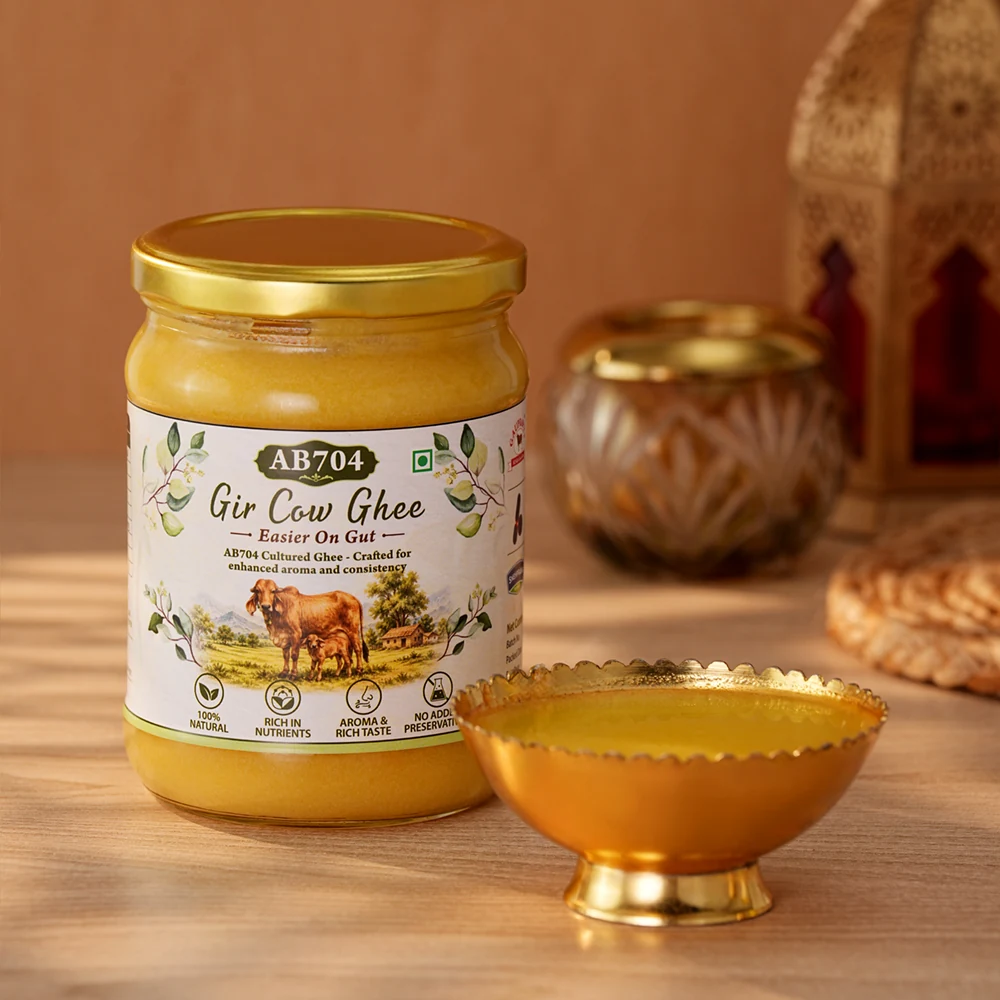
Packaged food in India has to list its ingredients, and for plain ghee the list should be very short. Ghee is a single ingredient food. The AB704 jar, for example, reads simply “Gir Cow Ghee”.
If a plain ghee lists anything else, such as added flavour, colour or another fat, that is worth a question before it goes in the basket. Flavoured ghee exists and is fine when it says so, but it should say so on the label.
Find the FSSAI licence number
Every food business in India that makes, packs or sells packaged food has to be licensed or registered with FSSAI, the Food Safety and Standards Authority of India. The licence number is a 14 digit number printed on the pack, usually near the manufacturer’s address, with the FSSAI logo.
You can check a number yourself. FSSAI’s FoSCoS portal (foscos.fssai.gov.in) lets anyone look up a licence. A missing number, a number with the wrong number of digits, or a number that does not match the business named beside it are all reasons to put the jar back.
Check who made it and who sells it
The label should name the business that manufactured the ghee and, where it is different, the business that markets it. On the AB704 jar there are three names, each with its own licence number: the manufacturer, the owner of the brand, and the marketer, which is us.
Many brands sell products made by someone else, and that is a normal way to run a food business. What matters is that the chain is written down and that each company can be traced. A label that names nobody is asking you to trust the front of the pack alone.
Read the dates and the batch number
A jar should carry a batch number and a date. Usually that is the date it was packed and a best before date. The batch number is what lets a brand trace one jar back to one production run, which is useful if you ever need to report a problem. If you contact us about a jar, the batch number and packed date on the rear label are the first things we will ask for.
Check the dates in the shop. A jar close to its best before date is not unsafe, but there is no reason to take it home when a fresher one is on the same shelf.
Look at the storage instructions
Good labels tell you how to keep the product. The AB704 label asks you to keep the lid tightly closed after every use, to use a clean and dry spoon, and to store the jar in a cool, dry and hygienic place away from direct sunlight. A label with no storage advice at all is a small sign that nobody thought about what happens after the jar leaves the shop. Our guide to how to store ghee at home explains the reasons behind each of those instructions.
Compare the nutrition table with care
Nutrition tables are printed per 100 grams, which makes two brands directly comparable. For ghee, expect the fat figure to be close to 100 grams and the carbohydrate and protein figures to be zero or very close to it, because ghee is almost entirely milk fat. The AB704 label, for instance, prints total fat at roughly 99 to 100 grams per 100 grams, with carbohydrates, protein and fibre at 0 grams.
Some labels print ranges rather than single figures, with a tilde in front, which means the values are approximate. That is normal for a natural product. Be more careful with a table that looks far from this pattern, or one that is missing altogether.
Treat front-of-pack claims as claims
Words such as pure, premium, traditional, ancient or farm fresh are descriptions chosen by the brand. They are not measurements, and they do not have a single agreed meaning. They can be true and still tell you very little.
It is more useful to look for claims that can be checked. “Cultured” is a good example. It describes a method, in which the cream is fermented with a culture before it is clarified into ghee, and a brand that uses the word can usually tell you which culture it used. Our article on what cultured ghee is and how it is made explains the method.
Look for evidence behind the claims
The last check happens off the label. Does the brand publish anything that backs up what the pack says? A laboratory report is the most useful thing a ghee brand can share, because it measures the product rather than describing it.
We publish every entry from the reports for AB704 on our science page, with each test explained in plain words, including the results that do not prove anything on their own. Whatever brand you buy, asking whether the results are available is a fair question.
A one minute checklist
- 01The ingredients line lists ghee and nothing else, for a plain ghee.
- 02A 14 digit FSSAI licence number is printed, and you can look it up.
- 03The manufacturer and the marketer are both named.
- 04The pack shows a batch number, a packed date and a best before date.
- 05Storage instructions are printed.
- 06The nutrition table is per 100 grams and looks like ghee.
- 07Front-of-pack claims are ones you could check.
- 08The brand shares evidence, such as laboratory results, when asked.
Frequently asked questions
Which number on a ghee label should I check first?
The FSSAI licence number. It is 14 digits long and should be printed near the manufacturer’s details. You can look it up on FSSAI’s FoSCoS portal to see that it belongs to the business named on the pack.
How many ingredients should plain ghee list?
One. Plain ghee is made from milk fat alone, so the ingredients line should read ghee, or cow ghee, or the equivalent. If anything else is listed, the label should say what it is and why.
Does the word cultured on a ghee label mean anything?
It describes the method. Cultured ghee is made from cream that has been fermented with a bacterial culture before it is clarified. Ask the brand which culture it uses. AB704 names its culture, a Direct Vat Set culture developed by ABsource Biologics, on the front of the jar.
Why does the batch number matter?
It links one jar to one production run. If you ever have a concern about a jar, the batch number and packed date let the brand trace it and look into what happened.
Where can I see the evidence behind AB704?
On the science page, which publishes all 65 laboratory test entries for AB704, and on the product page, which copies the label facts exactly as printed.